The Art of Bringing an Object to Life by Giving It the Appearance of Motion or Activity Is ã¢â‹
Neutron Stars
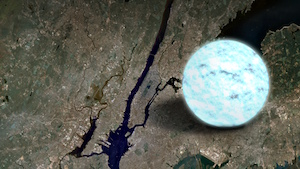
Neutron stars are formed when a massive star runs out of fuel and collapses. The very fundamental region of the star – the core – collapses, crushing together every proton and electron into a neutron. If the core of the collapsing star is between most one and 3 solar masses, these newly-created neutrons can stop the plummet, leaving behind a neutron star. (Stars with higher masses will continue to plummet into stellar-mass blackness holes.)
This collapse leaves behind the well-nigh dense object known – an object with the mass of a sun squished downwards to the size of a city. These stellar remnants measure about xx kilometers (12.5 miles) beyond. I sugar cube of neutron star material would counterbalance about 1 trillion kilograms (or 1 billion tons) on Earth – almost equally much as a mountain.
Since neutron stars began their beingness every bit stars, they are found scattered throughout the galaxy in the same places where we find stars. And similar stars, they can be found by themselves or in binary systems with a companion.
Many neutron stars are likely undetectable because they simply exercise not emit enough radiation. However, nether certain weather condition, they tin can be easily observed. A handful of neutron stars have been found sitting at the centers of supernova remnants quietly emitting X-rays. More often, though, neutron stars are found spinning wildly with extreme magnetic fields equally pulsars or magnetars. In binary systems, some neutron stars tin can exist institute accreting materials from their companions, emitting electromagnetic radiations powered by the gravitational energy of the accreting material. Below we innovate two general classes of non-quiet neutron star – pulsars and magnetars.
Pulsars
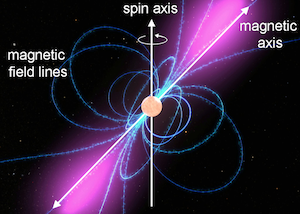
Near neutron stars are observed equally pulsars. Pulsars are rotating neutron stars observed to have pulses of radiation at very regular intervals that typically range from milliseconds to seconds. Pulsars accept very strong magnetic fields which funnel jets of particles out along the ii magnetic poles. These accelerated particles produce very powerful beams of light. Often, the magnetic field is not aligned with the spin centrality, so those beams of particles and lite are swept around equally the star rotates. When the beam crosses our line-of-sight, we see a pulse – in other words, we run into pulsars turn on and off equally the beam sweeps over Earth.
One way to think of a pulsar is like a lighthouse. At nighttime, a lighthouse emits a beam of light that sweeps across the sky. Fifty-fifty though the light is constantly shining, y'all only run across the beam when it is pointing directly in your management. The video below is an animation of a neutron star showing the magnetic field rotating with the star. Partway through, the bespeak-of-view changes so that we can see the beams of light sweeping across our line of sight – this is how a pulsar pulses.
This animation takes u.s. into a spinning pulsar, with its strong magnetic field rotating forth with information technology. Clouds of charged particles move along the field lines and their gamma-rays are beamed like a lighthouse buoy by the magnetic fields. Equally our line of sight moves into the axle, we see the pulsations once every rotation of the neutron star.
Credit: NASA/Goddard/ CI Lab
Magnetars
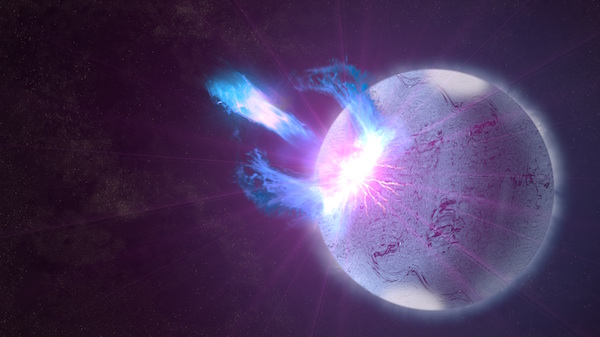
Some other type of neutron star is called a magnetar. In a typical neutron star, the magnetic field is trillions of times that of the Earth's magnetic field; however, in a magnetar, the magnetic field is another 1000 times stronger.
In all neutron stars, the crust of the star is locked together with the magnetic field so that any change in one affects the other. The chaff is under an immense amount of strain, and a small movement of the crust can be explosive. But since the chaff and magnetic field are tied, that explosion ripples through the magnetic field. In a magnetar, with its huge magnetic field, movements in the crust cause the neutron star to release a vast corporeality of energy in the form of electromagnetic radiation. A magnetar chosen SGR 1806-20 had a burst where in one-tenth of a second it released more than free energy than the dominicus has emitted in the last 100,000 years!
Text updated: March 2017
Additional Links
- Cool fact about this topic!
- FAQs on Neutron Stars, Pulsars, and Magnetars.
- Requite me additional resources!
Related Topics
- Supernovae
- X-ray Binaries
For Educators
- NCTM & NSES Standards
- The Life Cycle of Stars Booklet
- Show me related lesson plans
coffeltweentemeare.blogspot.com
Source: https://imagine.gsfc.nasa.gov/science/objects/neutron_stars1.html
0 Response to "The Art of Bringing an Object to Life by Giving It the Appearance of Motion or Activity Is ã¢â‹"
Post a Comment